Underfloor Heating Installation & Maintenance in Antalya
Wet underfloor heating (UFH) is becoming the heating system of choice in Antalya's villas, luxury apartments and renovation projects. It delivers silent, even warmth at lower water temperatures than radiators — making it an ideal match for condensing boilers and heat pumps. Tesisat Antalya provides full underfloor heating installation for new builds and retrofits, heat pump integration, smart thermostat set-up and ongoing maintenance across all Antalya districts. Our team includes English-speaking staff. Call us: +90 532 694 74 19
How Wet Underfloor Heating Works
Hot water from a boiler or heat pump is circulated through cross-linked polyethylene (PE-X) pipes embedded in the floor screed. The floor surface warms up to around 27–29°C and radiates heat upward into the room. Key differences from radiators:
- Lower flow temperature: Radiators need 70–80°C water; underfloor heating works with 35–45°C. This makes it far more efficient with condensing boilers and essential for heat pump systems.
- Even heat distribution: Heat rises from the entire floor area rather than from two points on the wall. No cold corners, no temperature layering.
- Silent operation: No ticking, no gurgling — UFH systems are completely silent.
- Wall space freed: No radiators means full flexibility for furniture placement and interior design.
System Components
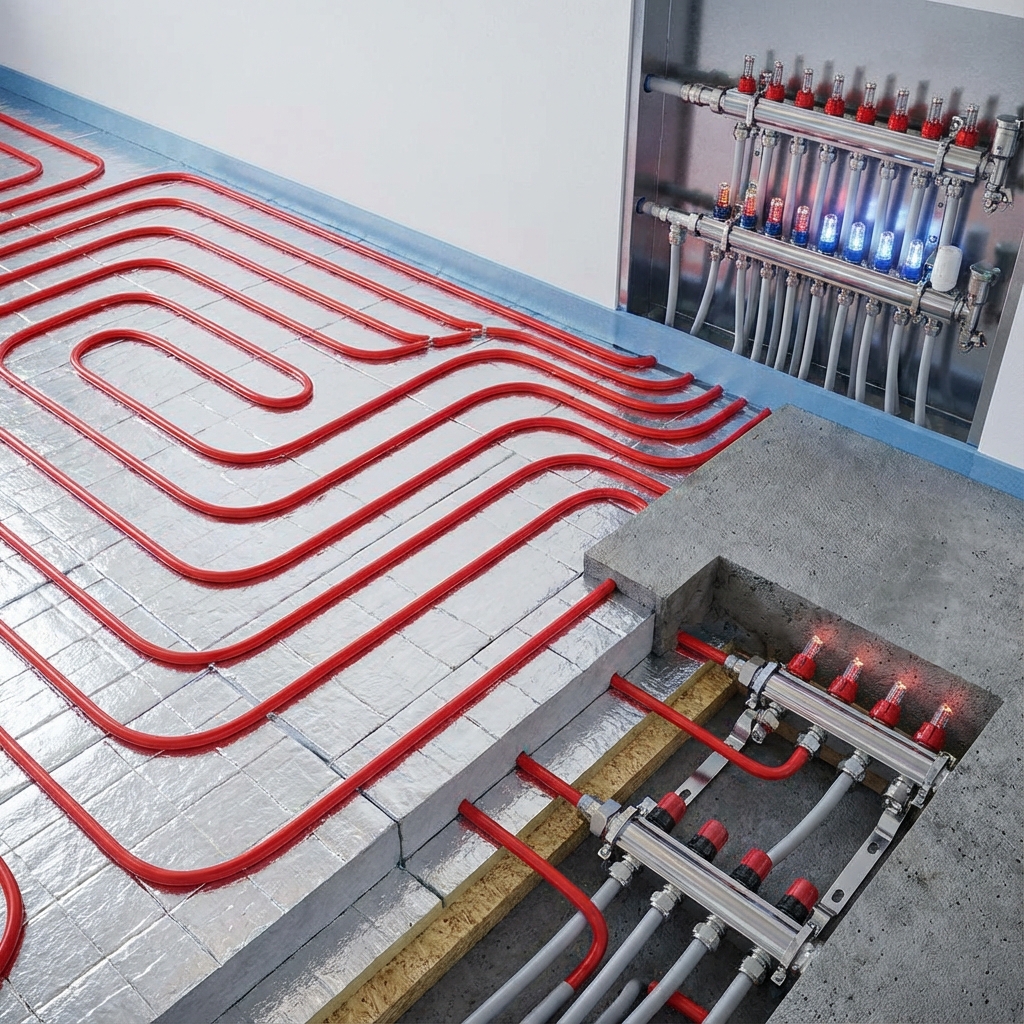
- PE-X or PE-RT pipes: Flexible, pressure-resistant pipes rated for 50+ years. No joints are buried in the screed — only continuous loops.
- Insulation board (EPS or XPS): Installed beneath the pipes to prevent downward heat loss. Typically 3–5 cm thick with integral pipe clips.
- Manifold (collector): Central unit distributing hot water to each room circuit. Fitted with actuators that open and close individual circuits in response to room thermostat signals.
- Room thermostats: Each room has its own thermostat for independent temperature control. Smart Wi-Fi thermostats allow remote control from your phone.
- Boiler or heat pump: Condensing boilers and air-source heat pumps are both ideal partners for UFH due to the low flow temperature requirement.
New Build Installation
Installing UFH during construction is the most cost-effective approach — no floor demolition is needed and the schedule aligns naturally with the screed pour. Our process:
- Room-by-room heat loss calculation to determine pipe spacing and circuit lengths.
- Insulation board laid on the structural floor.
- PE-X pipes clipped to the board in a spiral or meander pattern, one circuit per room.
- Pressure test at 6 bar for 24 hours before any screed is poured.
- Screed poured by the builder; minimum 5 cm depth above the pipes.
- After screed cure, manifold with actuators is mounted; room thermostats are wired.
- System commissioned: slow heat-up cycle, flow balancing, and room-by-room confirmation.
Retrofit Installation
Adding UFH to an existing apartment or house is possible in two ways:
- Standard retrofit: Existing floor covering and screed are removed; insulation and PE-X pipes are laid; new screed is poured. Floor level rises by 8–12 cm. Best done during a full renovation.
- Low-profile system: 16 mm slim pipes are set into 2–3 cm carrier boards without removing the existing screed. Floor rises by just 2–3 cm. Door thresholds rarely need adjustment. Popular in Antalya's older apartments where ceiling height is limited.
Heat Pump Integration
Antalya's mild winters make air-source heat pumps extremely efficient here. Winter air temperatures rarely drop below 5°C, so the heat pump operates at its highest COP (coefficient of performance) — typically 3.5–4.5, meaning 3.5–4.5 kWh of heat for every 1 kWh of electricity consumed. Combined with UFH's low flow temperature requirement, a heat pump + UFH system can reduce annual heating costs by 40–60 % compared to a standard gas boiler.
Underfloor Heating Maintenance
UFH systems require minimal maintenance but the following periodic checks keep them running efficiently:
- Annual manifold service: Actuator function test, valve leak check, air bleeding, pressure check and thermostat calibration.
- System flush (every 4–5 years): Chemical flush of PE-X circuits to remove any scale or magnetite build-up. A neutral or mildly alkaline formula is used — PE-X is sensitive to strongly acidic chemicals.
- Leak detection: If system pressure drops without visible leaking at the manifold, a thermal camera scan locates the underground leak without breaking up the floor unnecessarily.
Service Areas
- Konyaaltı Underfloor Heating
- Muratpaşa Underfloor Heating
- Kepez Underfloor Heating
- Döşemealtı Underfloor Heating
Frequently Asked Questions
- Can UFH be added to an existing apartment without a full renovation? Yes — our low-profile system adds only 2–3 cm to the floor height and can be installed without removing the existing screed.
- What floor coverings work with UFH? Tiles, marble, granite, vinyl and laminate all work well. Thick carpet significantly reduces heat transfer and is not recommended.
- How long does the floor take to warm up? The first heat-up from cold takes 3–6 hours. Once the system is running continuously, rooms maintain a steady temperature with no noticeable lag.
- Do I need a new boiler? Not necessarily. Your existing boiler will work if it can be set to 45°C flow temperature. A condensing boiler or heat pump will give you better efficiency at the low temperatures UFH requires.
- How long does installation take? For a 100 m² apartment: 2–3 days for the pipe laying; screed cure takes 3–4 weeks before commissioning.
- Do you speak English? Yes. Our team includes English-speaking staff and we regularly work with foreign property owners across Antalya.

